
Loading
Nishok Hospital - Orthopedic & Skin Specialist Hospital Contact Us.
Mon - Fri: 09:30am - 7:30pm
Balaghat, Madhya Pradesh

Advanced, precise, and personalised knee replacement surgery — led by Dr. Shrey Jain, Balaghat's robotic joint replacement surgeon.
Book a Consultation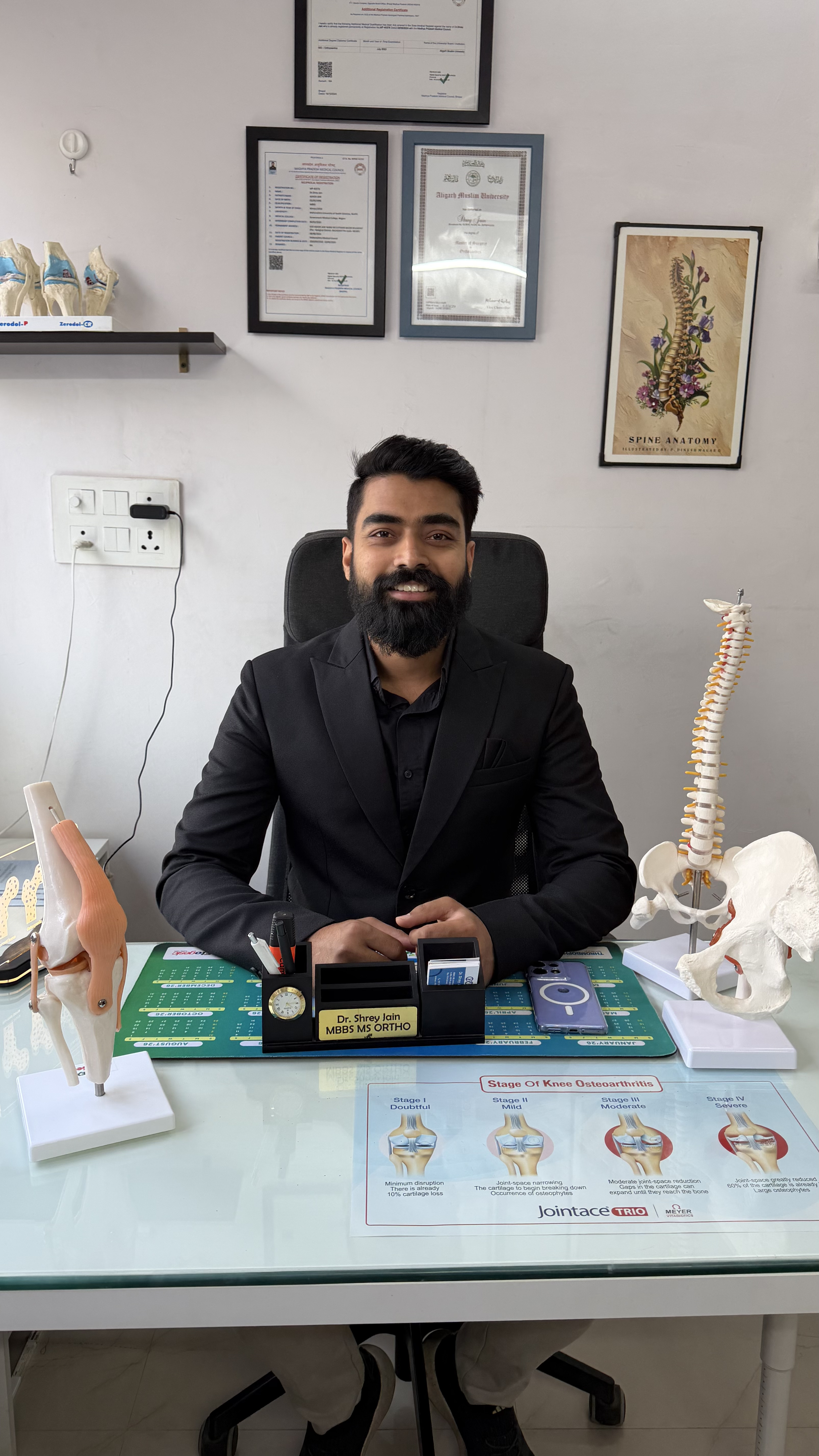
Dr. Shrey Jain is an orthopaedic surgeon based in Balaghat, with expertise in joint replacement, pediatric orthopaedics, spine surgery, and complex trauma care. He completed his MBBS from Government Medical College, Nagpur, and his MS in Orthopaedics from Jawaharlal Nehru Medical College. He also holds FJRS and FIPPP (IAOS) qualifications, along with a Diploma in FIFA (Swiss). Before returning to Balaghat, he worked as a lecturer at Mahatma Gandhi Institute of Medical Sciences, Sevagram, Wardha.
Dr. Shrey Jain is a robotic joint replacement surgeon, experienced in performing robotic-assisted knee replacement using the MISSO Robotic System.
Since joining Shaheed Bhagat Singh District Hospital, Balaghat in September 2024, Dr. Shrey has gone on to perform 100+ joint replacement surgeries overall, with 30+ completed in Balaghat itself — including several milestone "firsts" for the district.
Today, Dr. Shrey brings this same expertise and robotic-assisted precision to patients at Nishok Hospital, Balaghat.
Photo coming soon
Professional photo of Dr. Shrey with the robotic equipment
Dr. Shrey has led several landmark surgeries for Balaghat, including a number of "firsts" for the district:
First knee replacement surgery at a government facility in Balaghat (District Hospital Balaghat)
First hip replacement surgery at a government facility in Balaghat (District Hospital Balaghat)
First bilateral knee replacement surgery in Balaghat
First robotic knee replacement surgery in Balaghat
These milestones were covered by local media, including Divya Express, Patrika, and Balaghat Jabalpur Express.
Robotic-assisted joint replacement combines a surgeon's skill and judgement with advanced 3D imaging and real-time guidance. Instead of relying only on manual instruments, the surgeon uses a personalised surgical plan built from the patient's own CT scan — and a robotic arm that helps carry out that plan with a high level of consistency and accuracy.
Nishok Hospital uses the MISSO Robotic System (by Meril) for robotic-assisted total knee replacement. Some of its key capabilities:
Personalised 3D surgical planning based on the patient's own CT scan
Real-time, computer-guided precision during bone cutting and implant alignment
Built-in safety mechanisms, including automatic stoppage if bone movement exceeds a safe limit
Designed to support sub-millimetre accuracy in implant positioning
Importantly, the robot does not perform the surgery on its own — Dr. Shrey remains in full control throughout the procedure. The robotic arm simply helps execute the pre-planned surgical plan with greater precision than manual technique alone.
Robotic assistance changes several things for the patient, compared to conventional knee replacement:
| Comparison | Conventional | Robotic-Assisted |
|---|---|---|
| Surgical Planning | Based on 2D X-rays and standard sizing | Personalised 3D model from the patient's own CT scan |
| Alignment Accuracy | Depends on manual instruments and technique | Guided in real time, kept within the planned boundaries |
| Tissue Handling | Wider margins often used for safety | Tissue-sparing cuts guided by the pre-op plan |
| Recovery Experience | Standard post-op recovery timeline | Often smoother, more predictable early recovery |
Greater precision in bone cutting and implant alignment
Less tissue damage and reduced blood loss during surgery
Less pain and discomfort after surgery
Faster early recovery and quicker return to walking
Better implant fit, which can support longer implant life
Knee arthritis caused by any of the following: osteoarthritis, rheumatoid arthritis, avascular necrosis, or post-traumatic arthritis.
A CT scan of the affected joint is taken, along with routine investigations for a pre-anaesthesia check-up.
Surgery typically takes about 1.5 hours. Most patients begin walking and start physiotherapy the same evening.
Patients typically stay in hospital for 3 to 4 days.
Walking and physiotherapy usually begin the same evening as surgery. Stitches are removed after 14–16 days, and most patients return to normal daily activity around day 15.
A follow-up visit is scheduled around day 14–16 for stitch removal.
One of Dr. Shrey's early patients was a 52-year-old farmer from a village near Balaghat, who had been living with rheumatoid arthritis-related knee pain for nearly two years. After struggling with the cost and difficulty of repeated travel to a larger city for treatment, he underwent a successful knee replacement at a government facility in Balaghat — the first surgery of its kind performed there. He was walking with support the very next day.
Patient testimonial video coming soon
Dr. Shrey's work has been featured in local publications, including Divya Express, Patrika, and Balaghat Jabalpur Express, recognising Balaghat's first successful joint replacement surgeries at a government facility.
Answers to common questions about robotic-assisted knee replacement.
None — patients are encouraged to walk on the day of surgery itself.
Usually on the day of surgery itself, or the next day.
Most patients can start climbing stairs from day 3 onward.
With modern pain management techniques, most patients remain comfortable during the post-operative period.
No. The surgeon performs the surgery — the robot only assists with planning and precise execution, under the surgeon's full control.
No. The robotic system only executes what the surgeon plans and directs — it does not act independently.